City Views
City views (1993) 1996-2026
 Virtual excursions

Explore Slovenia through spatial visualizations of towns and squares, created over decades of digitizing our heritage.
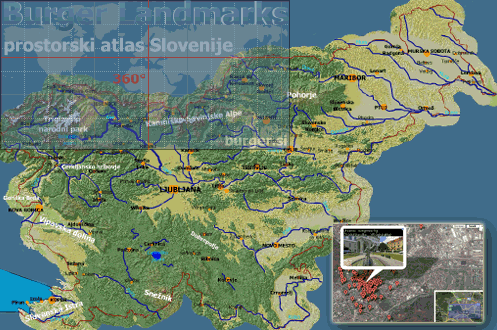
The City views project is one of the earliest and most ambitious attempts at digital humanities in Slovenia. Since 1993, when it was conceived under the name City view – Ljubljana as an Open-Air Museum, it has gradually grown from a local vision into an internationally recognized digital archive of Slovenian and foreign landscapes, towns, and settlements. Even in its original conception, it transcended the technological and cultural frameworks of the time: it was a pioneering attempt to create a virtual environment where a visitor could explore a city, its streets, squares, parks, and interiors of public buildings, as if walking through a large, dispersed museum.
Accessibility as a Core Concept
One of the key motives of the project was accessibility for people with mobility impairments. Virtual tours provided an experience that was unattainable for many in physical space: entering cultural institutions, viewing architecture, exploring historical centers, and walking through city paths without physical barriers. In this sense, City views is one of the first Slovenian projects to understand digital technology as a tool for inclusion – as a way to open cultural heritage to everyone.
First Publication of Ljubljana (1996) and Global Impact
In 1996, Ljubljana was published for the first time in a comprehensive, publicly accessible digital form. Most important locations – from the old town center to key public buildings – were documented and presented in a form that combined photography, spatial orientation, and museum interpretation. The city thus became a hybrid between real space and digital archive, between the urban environment and a museum.
It is important to emphasize that the City View project was also the conceptual basis for many subsequent similar projects worldwide. At a time when the global web did not yet have standardized tools for spatial representation, the project offered a conceptual and technological model that many adopted, adapted, or further developed.
Expansion to All of Slovenia and Beyond
Following the success of the Ljubljana segment, the project gradually expanded to other Slovenian settlements. Consequently, City views transformed from a local experiment into a national archive, which today represents an extremely rich visual and spatial record of Slovenia.
Slovenia has 6,036 registered settlements, including 104 urban settlements and 212 municipal centers. This exceptionally dispersed settlement structure – one of the densest in Europe – gives the project special significance. Documenting Slovenia means documenting thousands of places, from large urban centers to the smallest villages, which, despite their size, possess their own identity, history, and spatial logic.
Currently, only a selection of settlements is published on the website, as a large part of the early content has been moved to the Internet Archaeology section due to technological obsolescence (Java, QTVR, Flash). This shift is not only technical but also historical: it shows how rapidly the web has evolved and how important it is to preserve digital traces of the past.
The project did not stop at Slovenian borders. As time permitted, it was expanded to numerous other countries, which are presented in special chapters of the website. Many countries received their first virtual presentation within this project, which may have later been lost from collective memory but remains preserved in the City views archive.
Like any long-term cultural project, City views has experienced various phases of social and political interpretation. In certain periods, it even became a political tool for officials who wanted to use it to demonstrate their bureaucratic power or influence. Nevertheless, the project survived, primarily due to personal dedication, persistence, and self-funding. Within the limits of available time and personal resources, it continues to fulfill its mission: documenting space, preserving memory, and enabling accessibility.
Cultural and Historical Significance
The City views project has become more than a digital walk. It is:
- An archive of urban and rural space,
- A tool for researching cultural heritage,
- Didactic material,
- A resource for historians, architects, urban planners, and museologists,
- A bridge between the past and the future, as it preserves images of spaces that are constantly changing in reality.
From the original idea of Ljubljana as an open-air museum to an international archive of virtual landscapes, City views has become one of the most important digital cultural projects in Slovenia and beyond. Its value lies not only in technological innovation but in its humanistic vision: to enable accessibility, preserve memory, and create a space where everyone – regardless of their abilities – can walk through the cultural landscape of the world.
Ajdovščina

Begunje
Bled
Bohinjska Bistrica
Breginj
Brežice
Celje
Cerklje na Gorenjskem
Cerkno
Col
Domžale
Dvor
Gornji Grad
Hotedršica
Idrija
Izola
Jeruzalem
Jesenice
Jezersko
Kamnik
Koper
Kostanjevica na Krki
Kranj
Kranjska Gora
Lesce
Litija
Ljubljana
Ljubno
Logatec
Moravče
Murska Sobota
Nemški Rovt
Novo Mesto
Ormož
Osp
Piran
Portorož
Postojna
Ptuj
Radovljica
Rogatec
Rovte
Semič
Šempeter v Savinjski Dolini
Škofja Loka
Slovenj Gradec
Slovenska Bistrica
Slovenske Konjice
Spodnja Idrija
Šebrelje
Šmartno pri Litiji
Štanjel
Tolmin
Tržič
Vipava
Vipavski Križ
Vinica
Žalec
Žiri
Žužemberk