 OPEN FULL SCREEN VIEW

German Third Reich, which was the military superpower of that time, attacked the territory of Slovenia in April 1941. The German Army occupied the Slovenian regions of Upper Carniola, Carinthia, Styria and the part of Lower Carniola with about 800,000 residents. Slovenians had decided for self-defence and the fight against Fascism and Nazism. The Slovenian Army was organized.
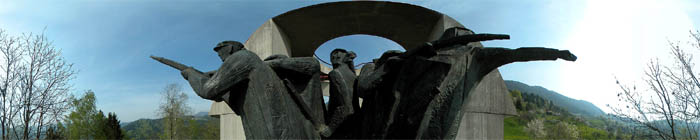
The Battle of Drazgose took place nearby Železniki in the Upper Carniola region, between the 9th and 11th of January 1942. It was the first Slovenian frontal battle (The Cankar battalion) in the Second World War against the Nazi military division.
The armament was very poor with no artillery and a very small number of machine guns. The only advantage was the strategic position on "Bickova skala" (rock rising). Despite the numerical superiority and modern armament of the Nazis, the frontal battle lasted three days. The myth of Nazi superiority was broken and the genocide was slowed down.
The battle displayed that at that time the Slovenian Army was not yet prepared for frontal battles, so the military tactic moved to partisan warfare until 1943, when Italy capitulated. The Slovenian Army then acquired proper armament and eventually liberated Slovenian ethnical territory by May 1945.